The AllSkyKamera case
The AllSkyKamera project is more than just a printable camera housing. It is a broader community and network built around Raspberry Pi based all-sky cameras, shared observations, and practical citizen-science use. For Allsky users, one of the most immediately useful parts of that project is Stefan’s modular 3D-printable case design.
If you are looking for a housing that has clearly been designed by someone who has actually built and used this kind of system outdoors, the AllSkyKamera case is worth serious consideration. It is not presented as a generic plastic box. It is a purpose-built enclosure intended for an all-sky camera with attention paid to wiring, dome sealing, dew control, and the practical realities of long-term outdoor use.
What It Is
Stefan has designed and published a modular housing for all-sky camera systems that can be 3D printed and adapted to your own build.
The case is designed so that key components can be mounted cleanly inside the housing, including:
- the Raspberry Pi,
- the camera,
- PoE hardware,
- a fan,
- a relay,
- optional external sensors.
One of the strongest features of the design is that it does not treat the extra hardware as an afterthought. The AllSkyKamera approach is deliberately modular, which makes it easier to build a simpler enclosure first and then expand it later if you want to add environmental sensing or other extras.
That modularity is especially helpful for new builders. You do not have to start with the most complicated version on day one. You can build the basic enclosure first, prove that the camera and Pi work reliably, and only then add more complexity if you need it.
Why It Stands Out
Many 3D-printable enclosures look good in renders but tell you very little about how they will behave outdoors. The AllSkyKamera material is useful because it discusses the parts of the build that actually matter in practice:
- dome fit,
- sealing,
- water management,
- dew prevention,
- print material choice,
- print settings,
- assembly order.
That makes the project feel much closer to a practical field-tested design than to a purely visual model.
The AllSkyKamera site also recommends a very sensible workflow: test the whole system first as an open prototype, then move it into the final housing. That is good advice. It is much easier to debug camera, Raspberry Pi, wiring, heater, relay, and sensor problems before everything is packed into the finished enclosure.
Dome, Sealing, And Dew Control
The AllSkyKamera documentation places a lot of emphasis on the dome and sealing arrangement, and rightly so. For an all-sky build, the dome is not just a transparent cover. It is the front window of the whole system, and small problems there can ruin image quality or long-term reliability.
The project specifically highlights:
- the fit of the acrylic dome,
- even pressure on the O-ring,
- a smooth sealing surface,
- reliable water tightness,
- active dew or fog reduction.
This is all highly relevant to real-world Allsky builds. A small leak may be enough to introduce moisture, and a dome that fogs repeatedly can make an otherwise good camera frustrating to use. The AllSkyKamera approach therefore treats sealing and dew prevention as core design concerns rather than optional finishing touches.
The site also notes that a dew heater ring or 12V resistors can be used to reduce fogging, and that proper relay switching and wiring matter. That fits well with the sort of practical outdoor thinking most Allsky users eventually arrive at: clear optics are just as important as good software settings.
Material Choice And Printing
The AllSkyKamera guidance also gives useful advice on print materials.
The main recommendation is:
- ASA for the best long-term outdoor durability,
- PETG as a workable alternative, especially for prototyping or less exposed parts.
That is a sensible distinction. ASA is recommended because it offers better UV resistance and temperature stability, which matters if the housing is going to spend long periods outdoors in sun, frost, and summer heat. PETG is easier for many people to print and can still work well, but the project notes that it may age faster in stronger UV and heat.
For Allsky users deciding how much effort to put into the first print, this gives a good practical rule:
- use PETG if you are prototyping or validating the design,
- use ASA for critical exterior parts if you want a more durable final build.
Downloads And Design Sources
Stefan has made the housing models available in several useful forms, which is one of the reasons the project is easy to recommend. You are not limited to looking at photos and trying to recreate the design from scratch.
The main public sources are:
According to the AllSkyKamera site, the downloadable project includes:
- models and STL files,
- notes on the dome and O-ring,
- water-tightness guidance,
- print settings per component,
- an assembly guide for an earlier version,
- practical notes from real-world use.
That combination is very useful. It means you are not only downloading printable parts, but also getting some of the reasoning behind the design.
The site also notes that the 3D models and STL files are licensed under CC-BY-3.0-NC, so if you plan to modify or reuse them, it is worth reading the licence terms directly.
Current Version Notes
The AllSkyKamera site currently describes Version 8 of the housing files and lists changes such as:
- an improved camera head with dew drip-off,
- a clamping ring with better water drainage,
- an adapter for 22 mm heating resistors,
- a revised cover plate with a water stop,
- improvements to the intermediate plate.
These details are helpful because they show the design is being iterated for practical outdoor performance rather than remaining fixed as a first draft.
The Wider AllSkyKamera Project
If you want more than just the enclosure, the broader AllSkyKamera site is worth exploring.
The project presents itself as a network for Raspberry Pi based all-sky cameras, with an emphasis on shared observations, public camera pages, automatic processing, and citizen-science value. The site describes benefits such as:
- automatic server-side generation of keograms and star trails,
- timelapse and night video products,
- long-term and seasonal visual summaries,
- central handling of optional sensor data,
- a public camera page within the network,
- participation in a larger observation community.
In other words, the case is only one part of a wider ecosystem. If you already run an Allsky installation and like the idea of your camera contributing to a shared network, the Join us page is the obvious next place to look.
The site currently says that participation is aimed at Raspberry Pi based all-sky cameras, ideally using a Pi 4 or Pi 5 with the HQ Camera, though older models are also welcomed. It also describes a simple three-step joining flow based around requesting a secret key, enabling uploads, and then going live in the network.
Practical Advice For Allsky Users
If you are considering this housing for an Allsky build, a sensible approach would be:
- Read the housing page carefully before printing everything.
- Start with an open prototype so you can validate the camera, Raspberry Pi, wiring, and any heaters or sensors.
- Decide early whether you are building a simple camera-only enclosure or a more modular sensor-equipped version.
- Think about dome sealing and dew prevention from the beginning, not as a later fix.
- Print final exterior parts in a material suited to long-term outdoor use if the camera will be permanently installed.
That last point matters. A housing that works well on the bench is not automatically ready for a full season outdoors. The AllSkyKamera guidance is strongest where it keeps bringing the design back to outdoor reality.
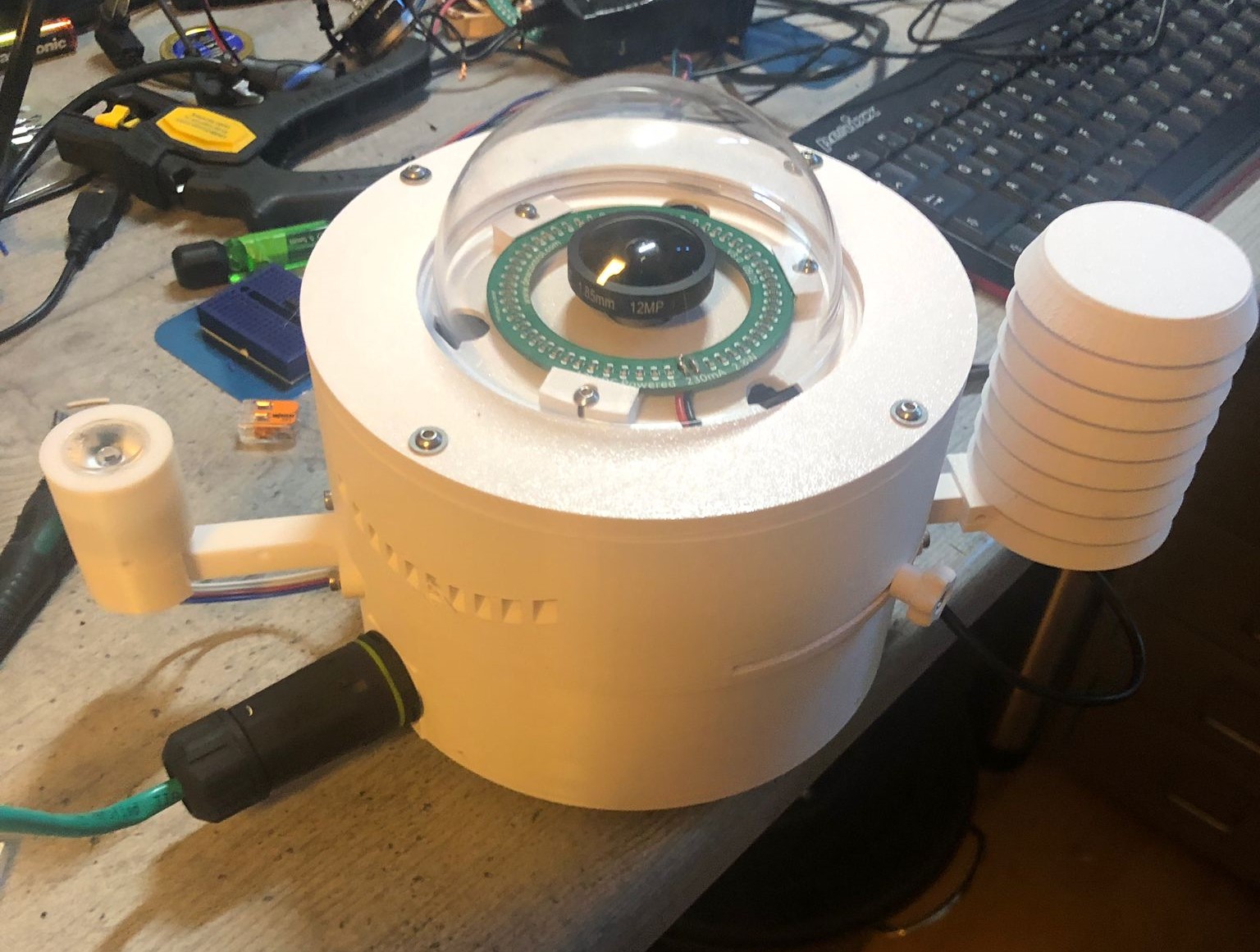
Camera housing with mounted components
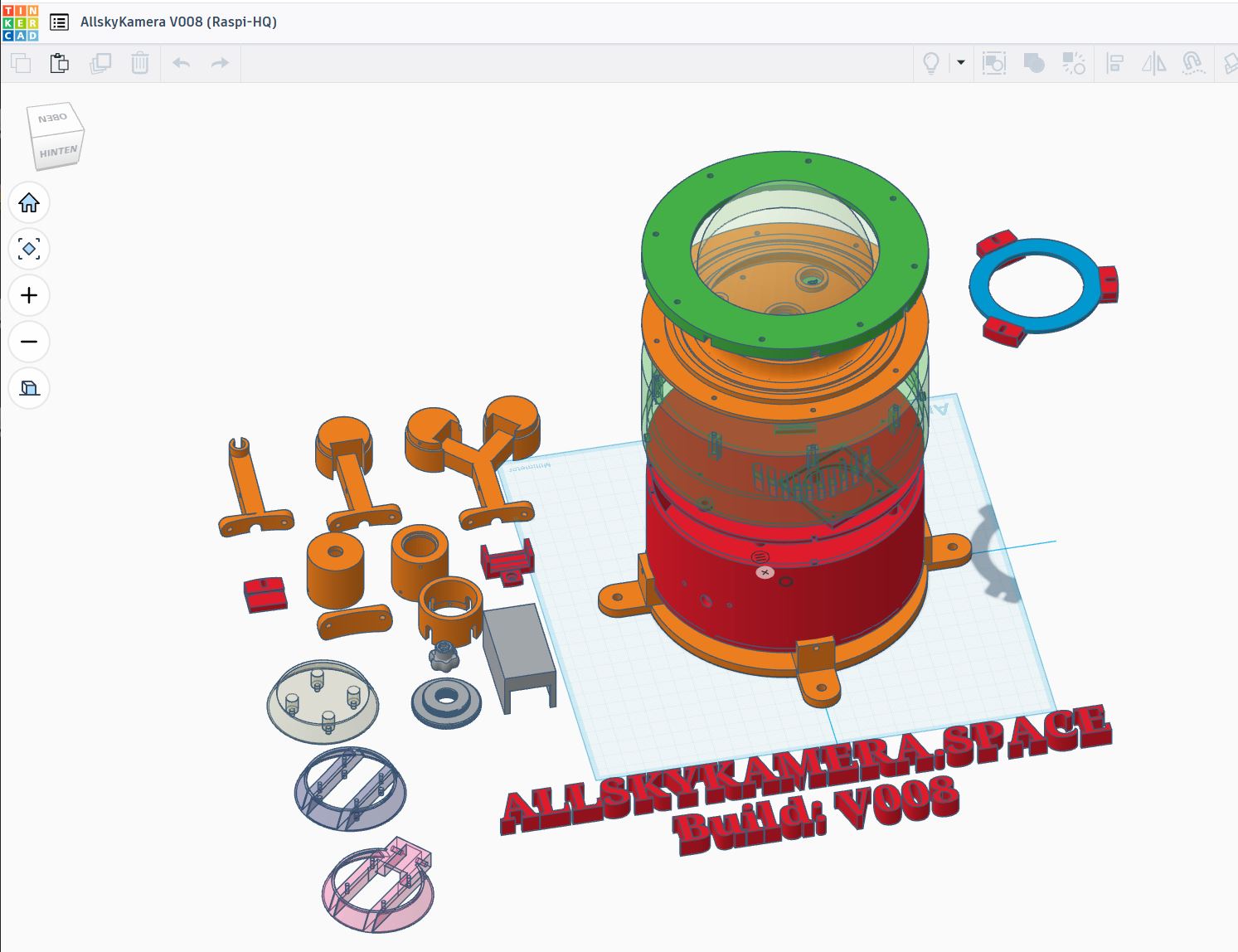
The Tinkercad models
Summary
The AllSkyKamera case is a strong option for Allsky users who want a thoughtfully designed 3D-printable enclosure rather than a generic box. Its real strengths are the modular design, the attention paid to dome sealing and dew control, and the fact that it sits inside a larger project with practical documentation and an active network concept behind it.
If you want to print your own housing, it is worth reading the AllSkyKamera build pages in full rather than only downloading the models. The additional notes on sealing, material choice, and outdoor operation are at least as valuable as the STL files themselves.